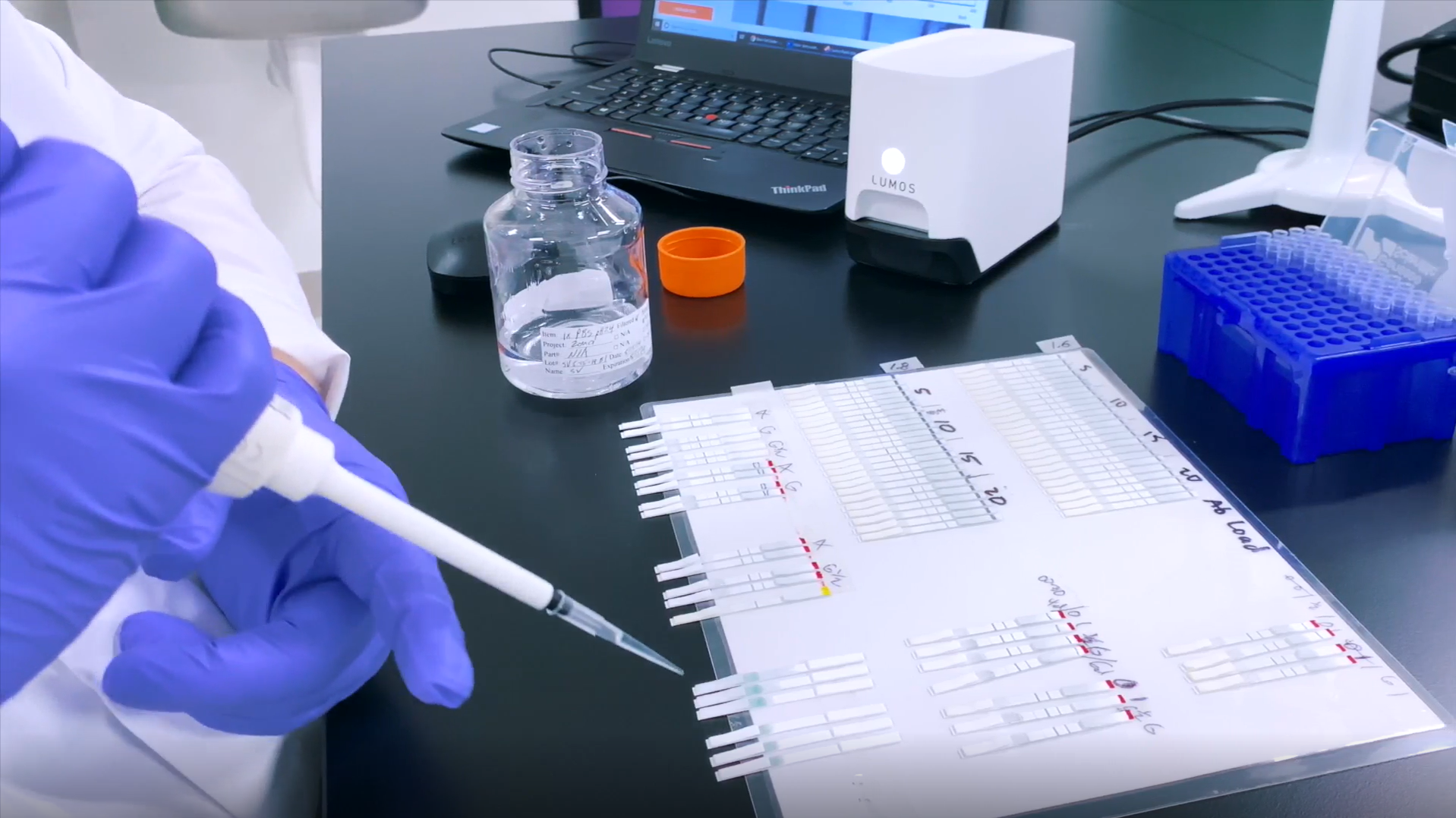
Assay Development
Our experienced assay team manages the full development program for diagnostic tests, from sourcing and/or generation of reagents, right through to verification, validation and design transfer.
We bring over 30 years of experience in assay development and widespread knowledge of the diagnostic testing market.

Contact us to learn more about Lumos Assay Development
Contact usFull Assay Development Capabilities
- Antibody design and development for small molecules through to proteins
- Immunoassay test development using lateral flow, ELISA and novel point-of-care (POC), microfluidic and sensor platforms
- Detection of nucleic acids and amplification products
- Translation of bench protocols onto diagnostic devices
- Conjugation to a range of visible and fluorescent detection chemistries
- Qualitative, semi-quantitative and quantitative formats
- Single and multi-analyte assay configurations
- Broad range of specimen types, including human, veterinary and environmental samples
- In-house OEM manufacturing of reagents, test consumables and kits
Lumos Assay Expertise
The Lumos Assay Development Team has broad experience over a wide range of assays, configurations and specimen types.
Assay Type
- Lateral Flow
- Enzyme-linked Immunosorbent Assay (ELISA / EIA)
- Protein Chemistry
- Enzymatic systems with a variety of substrate options
- DNA lateral flow (NALF)
Labels
- Gold Nanoparticles
- Latex particles - visible and fluorescent
- Magnetic bead
- Visual dyes
Assay Configurations
- Qualitative, Semi-Quantitative & Quantitative
- Multiplexing - within strip and multi strip systems
- Lateral flow, macro and microfluidic systems
Specimen Types
- Whole Blood / Serum / Plasma
- Saliva
- Urine
- Environmental samples
- Food
How we do it
End-to-End Assay Development Process
Lumos assay development follows a phased approach, with a focus on reducing project and product risk while matching the development effort with your business requirements. Lumos works collaboratively with our partners, bringing a wealth of product development expertise across a range of assay types and platforms, combined with a flexible approach.
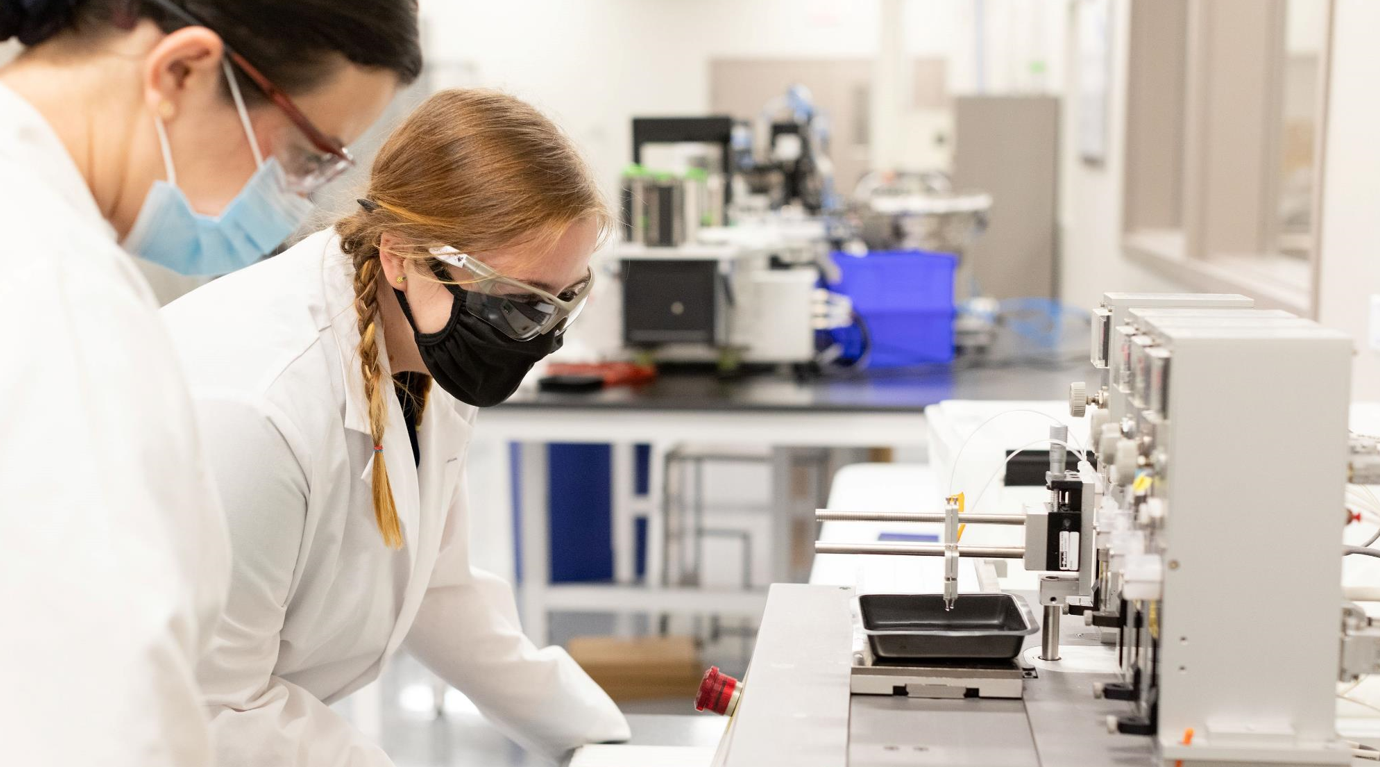
Phase 0 - Product Definition & Planning
Lumos begins by obtaining a thorough understanding of the customer and product needs, ensuring the key specifications and design elements are fully understood from a scientific and market perspective. Any existing partner reagents, platform, and other relevant information is considered prior to formulating a recommended path forward.
Phase 1 - Feasibility
The initial technical program will focus on building up the core components of the assay in a stepwise approach. Our assay development team is experienced in reagent design, conjugation chemistry, and formulation to maximize stability in liquid, dried and lyophilized formats.
Phase 2 - Development
Assay maturity is progressed to the final format with real samples, evaluating performance to key requirements along the way and optimizing as required. Pilot product builds and pre-verification studies are performed to reduce risk for subsequent formal testing phases.
Phase 3 - Verification & Initiate Design Transfer
Formal Verification studies are conducted, tailored to meet relevant regulatory, industry body and business needs. Raw material specification, assay formulations and methods and quality control procedures are translated into formal manufacturing documents. Manufacturing process validation is conducted either internally at Lumos or external providers.
Phase 4 - Validation & Complete Design Transfer
Assay cartridges are manufactured to ISO 13485 ready for formal studies required for regulatory clearance or approval.
Throughout the development program, our experienced Project Management Office will ensure clear communication of project progress and tracking against timelines and budget.
Platforms: Lumos leverages its existing gold-standard assay chemistry methods and digital reader platforms to expedite timelines, minimize costs and mitigate product risks to accelerate time to market. Our in-house assay development Centers of Excellence program evaluates novel chemistries and materials, ensuring we start with a near optimal configuration for a product needs.
Lumos possesses the expertise to guide your product seamlessly through verification, validation, and manufacturing stages, while adhering to FDA and ISO compliant processes as required according to your product and business requirements.
End-to-end Development Process
Lumos initiates each project by collaborating closely with its partners to gain a comprehensive understanding of both the customer's needs and the prevailing market dynamics. Employing established methodologies for market assessment and defining end-user requirements, we discern the optimal solution for our partners. This approach may entail on-site visits to laboratories and clinics, enabling us to gain valuable insights into the operational environment.
Our profound comprehension of the market intricacies informs our development process, ensuring that customer needs remain central at every stage. Adhering to a standardized phased approach, we leverage our established optical technologies, data analytics, and cloud infrastructure to expedite timelines, minimize costs, and mitigate product risks, thereby accelerating time-to-market.
With our complete in-house development team, we effectively streamline the parallel progression of individual components within a Proof of Concept POC diagnostic system. This capability is crucial in delivering the highest quality product within specified timelines.
Lumos possesses the expertise to guide your product seamlessly through verification, validation, and manufacturing stages, while adhering to FDA and ISO compliant processes as required according to your product and business requirements.
Frequently asked questions
What assay formats and configurations can Lumos Diagnostics develop?
Lumos Diagnostics provides full-cycle assay development, specializing in custom lateral flow assays (LFAs), as well as enzyme-linked immunosorbent assays (ELISA), enzymatic systems, and DNA lateral flow (NALF). We support:
• Configurations: Qualitative, semi-quantitative, and fully quantitative tests.
• Architecture: Sandwich, competitive, and nucleic acid assay formats.
• Multiplexing: Single-strip multiplexing and multi-strip cassette systems.
Can Lumos Diagnostics develop assays for complex or raw biological sample types?
Lumos Diagnostics assay development team formulates custom sample treatment buffers and selects optimized sample/separator pads to handle complex sample types, including whole blood, serum, plasma, saliva, urine, swab eluates, and environmental or food samples.
How does Lumos Diagnostics combine multiple biomarkers into a single point-of-care test?
Lumos Diagnostics engineers multiplex tests by coordinating every element of assay design to ensure each biomarker is detected accurately in one device. This includes test architecture, strip layout, reagent interactions, sample flow, cassette geometry, reader field of view, calibration and result interpretation. Depending on the application, multiplexing can be achieved within a single strip or across multiple strips housed in one cassette. Where multiplex interpretation calls for a reader, Lumos Diagnostic's customizable, market-ready reader platforms can be adapted to support the panel's specific output needs. Across all approaches, development is driven by minimizing cross-reactivity between targets while maximizing precision, usability, and manufacturability at scale.
How does Lumos Diagnostics measure small molecules using a lateral-flow assay?
Lumos Diagnostics measures small molecules using competitive assay architectures, specifically designed for targets too small to support standard sandwich immunoassays. Small molecules such as drugs, hormones and metabolites, often lack enough distinct binding sites to support a standard two-antibody sandwich assay, so a competitive assay design is used to successfully measure these small targets. Getting this format right requires careful control across several variables, including reagent affinities, immobilized competitor design, detector-particle selection, membrane and buffer optimization, calibration modeling, sample matrix effects and reader-based quantitation; each of which Lumos Diagnostics optimizes as part of assay development.
When should fluorescent detection be used over visual detection?
Fluorescent labels and optical readers become the better choice when visual detection does not deliver the sensitivity, dynamic range or quantitative precision a given application requires. Development of fluorescence-based assays needs to consider label chemistry, background, optical excitation and detection, calibration, strip geometry, environmental robustness, cost, usability and manufacturing complexity. When fluorescence is the right call, Lumos Diagnostic's customizable, market-ready reader platforms provide a ready foundation for optical detection, helping partners avoid building reader hardware from the ground up.
When does a lateral-flow assay require a reader?
A reader is appropriate when a product needs quantitative or semi-quantitative output, tighter consistency near a critical decision threshold, fluorescent detection, multiplex interpretation, automated result capture, connectivity, or reduced dependence on subjective visual interpretation. When a reader is the right fit, Lumos Diagnostics offers customizable, market-ready reader platforms that can be adapted to a partner's specific assay and product requirements, helping accelerate development without starting from scratch.
Does Lumos Diagnostics support the full product lifecycle beyond R&D?
Lumos Diagnostics supports all stages of the diagnostic product lifecycle, following a five-phase, risk-managed development process: Phase 0 (Product Definition & Planning), Phase 1 (Feasibility), Phase 2 (Development), Phase 3 (Verification) and Phase 4 (Validation & Design Transfer). Each phase is designed to reduce project and product risk while matching development effort to business requirements. The Lumos Diagnostics offering includes in-house OEM manufacturing of reagents, assay cartridges, consumables and kits, to ISO standards such as ISO 13485 or ISO 9001, supporting a seamless transition from development into formal studies for regulatory clearance and sale. Lumos Diagnostics also provides reader platform development and customization, clinical trial support, regulatory strategy and execution (including FDA submission and CLIA waiver pathways) and commercialization, demonstrated end-to-end through Lumos Diagnostics' own FebriDx product.
What makes Lumos Diagnostics different from other assay development partners?
Lumos Diagnostics offers end-to-end point-of-care diagnostic development and manufacturing, including assays and test kits, digital reader platforms, clinical, regulatory, and quality services, eliminating the need to coordinate multiple vendors. Lumos Diagnostics develops both visual and digital read tests using its own market-ready reader platforms for improved test performance and quantitation. Lumos Diagnostics brings proven, real-world experience highlighted by our own product, FebriDx, which Lumos Diagnostics took through development and clinical trials, achieved FDA 510(k) clearance and CLIA waiver, and is now manufactured in Lumos Diagnostic’s ISO 13485 and MDSAP compliant facility in Carlsbad, California.