FebriDx® — help rule out bacterial infections in minutes with a 99% negative predictive value
-
Help rule out bacterial infections in minutes* with a 99% NPV¹
Learn more*Do not read results after 1 hour or before 10 minutes.
¹See the U.S. Instructions for Use (IFU) at LumosDiagnostics.com.




Redefine your acute respiratory patient visit this cold and flu season.
Contact a specialists to get started with FebriDx.
Get Started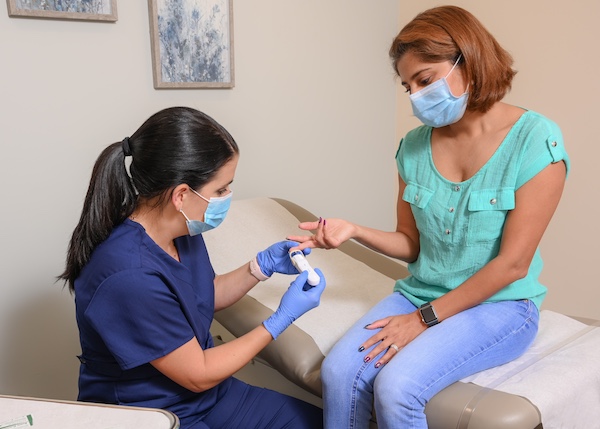
Help Rule Out Bacterial Infection in Minutes* with a 99% NPV1
FebriDx is a CLIA-waived fingerstick test that uses dual-biomarker technology, measuring MxA and CRP to help differentiate bacterial from non-bacterial etiology at the point of care.
Easy-to-use and instrument-free, FebriDx requires only a 5 µL fingerstick sample1 and delivers results in minutes.*
Why FebriDx
Support treatment decisions in acute respiratory infection
FebriDx helps the clinician provide a timely, targeted treatment plan and may reduce inappropriate antibiotics during the visit.
-
Bring clarity to overlapping symptoms
Helps clinicians differentiate bacterial infection from non-bacterial etiology when respiratory symptoms look alike.
-
Make decisions during the visit
Clear, objective test results support treatment and patient-management decisions before the patient leaves
-
Support patient conversations
A visual result helps clinicians explain the treatment plan, including when antibiotics aren’t needed.
-
Support antimicrobial stewardship
Helps identify patients who may benefit from antibiotics while reducing unnecessary prescribing.3–5
Hundreds
of urgent care and primary care clinics across 29 states have adopted FebriDx® in its first year as a CLIA-waived test.
Trusted in outpatient care
The decision to implement FebriDx® was not a question at all. Our clinicians quickly recognized the value of being able to differentiate between bacterial and non-bacterial infections early in the patient visit. With FebriDx, we can initiate testing during the initial visit and have results in minutes.*
Individual experiences may vary.
*Read results within one hour and after ten minutes.

Learn more about FebriDx
Learn more
- Harris AM, Hicks LA, Qaseem A. Appropriate antibiotic use for acute respiratory tract infection in adults: advice for high-value care from the American College of Physicians and the Centers for Disease Control and Prevention. Ann Intern Med. 2016;164(6):425-434.
- Centers for Disease Control and Prevention (CDC). National Ambulatory Medical Care Survey. National Center for Health Statistics. Updated December 30, 2021. Accessed Jan, 2024, https://www.cdc.gov/nchs/ahcd/about_ahcd.htm
- Renati S, Linder JA. Necessity of office visits for acute respiratory infections in primary care. Fam Pract. 2016;33(3):312-317.
- Centers for Disease Control and Prevention (CDC). Measuring Outpatient Antibiotic Prescribing. Updated Oct 2022. Accessed Feb 2024, https://www.cdc.gov/antibiotic-use/data/outpatient-prescribing/index.html
- Centers for Disease Control and Prevention (CDC). Antibiotic Resistance Threats in the United States, 2019. U.S. Department of Health and Human Services. Updated Dec 2019. Accessed Jan 2024, https://www.cdc.gov/drugresistance/pdf/threats-report/2019-ar-threats-report-508.pdf
- Shapiro NI, Self WH, Rosen J, et al. A prospective, multi-centre US clinical trial to determine accuracy of FebriDx point-of-care testing for acute upper respiratory infections with and without a confirmed fever. Ann Med. Aug 2018;50(5):420-429. doi:10.1080/07853890.2018.1474002
- Shapiro NI, Filbin MR, Hou PC, et al. Diagnostic Accuracy of a Bacterial and Viral Biomarker Point-of-Care Test in the Outpatient Setting. JAMA Netw Open. Oct 3 2022;5(10):e2234588. doi:10.1001/jamanetworkopen.2022.34588
- Carlton HC, Savović J, Dawson S, Mitchelmore PJ, Elwenspoek MM. Novel point-of-care biomarker combination tests to differentiate acute bacterial from viral respiratory tract infections to guide antibiotic prescribing: A systematic review. Clinical Microbiology and Infection. 2021