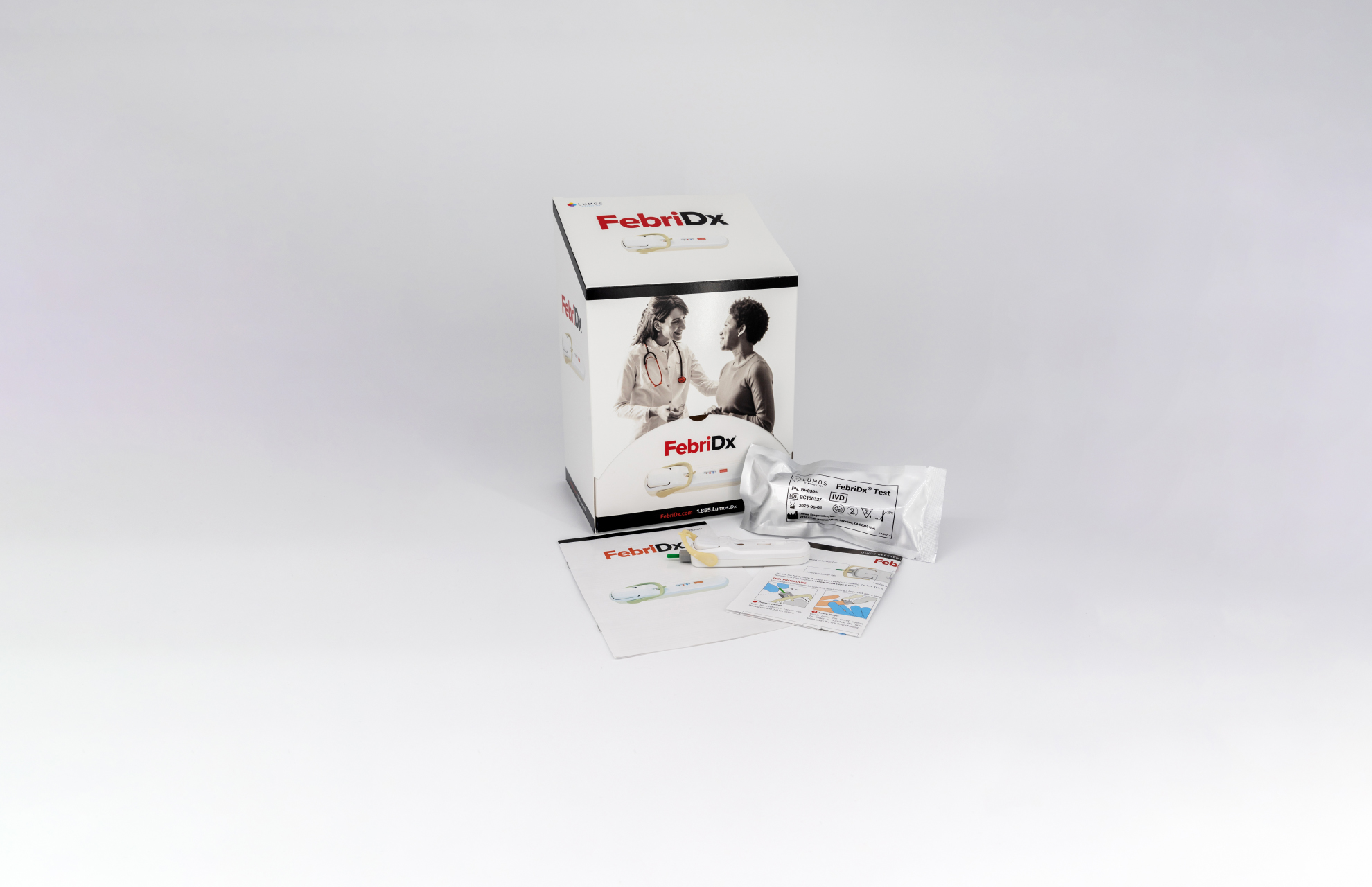
FebriDx US
The science
The science behind the accuracy

FebriDx = 2 Biomarkers
No single biomarker can differentiate bacterial from non-bacterial infection. The FebriDx test utilizes a proprietary combination of two host immune response biomarkers to aid in differentiating bacterial infection from non-bacterial etiology.1
CRP (C-Reactive Protein) is a nonspecific, acute-phase protein that is upregulated during the presence of acute inflammation, including response to infection. CRP is predominately produced by the liver in response to inflammatory cytokines such as IL-6 and assists in pathogen recognition and phagocytosis by macrophages.2 Infection is a potent stimulus of CRP elevation, which occurs within 4-6 hours of infection, doubles every 8 hours and peaks after 36 hours.3 At low levels CRP is sensitive but non-specific for bacterial infection.4
MxA (Myxovirus resistance protein A) is an innate host response biomarker that elevates in the presence of acute viral infection but is not specific to a particular type of virus. MxA has a low basal concentration of less than 15 ng/mL, a fast induction time of 1-2 hours, and a long half-life of 2.3 days.5 Numerous clinical studies demonstrate that MxA protein expression in peripheral blood has been shown to be a sensitive and specific marker for viral infection.6-7 MxA is specific for viral infection only and is not elevated in the presence of a bacterial infection.6-8
Neither MxA nor CRP alone is sensitive or specific enough to differentiate bacterial infection from non-bacterial etiology.4,6,9,10 At a low-level cut off, 20mg/L, CRP is very sensitive but non-specific at confirming bacterial infection. At a high-level cut off; 80-100mg/L, the reverse is true.3,9
By combining the acute phase inflammatory protein, CRP, with a specific viral marker, MxA, FebriDx achieves the sensitivity and specificity to aid in the differentiation of bacterial from non-bacterial acute respiratory infection.1
LOW-LEVEL CRP CUT OFF MAY LEAD TO THE OVER PRESCRIPTION OF ANTIBIOTICS FOR NON-BACTERIAL ETIOLOGIES.
A HIGH-LEVEL CRP CUT OFF MAY MEAN PATIENTS WITH BACTERIAL INFECTIONS COULD BE MISSED.
FEBRIDX DUAL BIOMARKER TECHNOLOGY (CRP + MXA) CAN DIFFERENTIATE BACTERIAL INFECTION FROM NON-BACTERIAL ETIOLOGIES.
FebriDx multi-center clinical study1
Multi-center, prospective, clinical trial demonstrated high sensitivity and specificity of FebriDx in differentiating bacterial from non-bacterial acute respiratory infection.
The study was conducted at 20 point-of-care testing sites. FebriDx was compared to a composite Clinical Reference Algorithm that incorporated pathogen detection testing including bacterial culture and multiplex PCR in addition to measures of host immune response.
FebriDx has a 99% NPV to rule out a bacterial infection.1
Characteristic |
Estimate |
95% CI |
|---|---|---|
| PPA | 93.2% (68 / 73) | 84.9% - 97.0% |
| NPA | 88.4% (374 / 423) | 85.0% - 91.0% |
| PPV | 58.1% (68 / 117) | 49.1 - 66.7% |
| NPV | 98.7% (374 / 379) | 96.9% - 99.4% |
PPA = positive percent agreement
PPV = positive predictive value
NPA = negative percent agreement
NPV = negative predictive value
- Shapiro NI, Filbin MR, Hou PC, et al. Diagnostic Accuracy of a Bacterial and Viral Biomarker Point-of-Care Test in the Outpatient Setting. JAMA Netw Open. Oct 3 2022;5(10):e2234588. doi:10.1001/jamanetworkopen.2022.34588
- Ansar W, Ghosh S. C-reactive protein and the biology of disease. Immunologic Research. 2013/05/01 2013;56(1):131-142. doi:10.1007/s12026-013-8384-0
- Bray C, Bell LN, Liang H, et al. Erythrocyte sedimentation rate and C-reactive protein measurements and their relevance in clinical medicine. Wmj. 2016;115(6):317-21.
- Hatherill M, Tibby SM, Sykes K, Turner C, Murdoch IA. Diagnostic markers of infection: comparison of procalcitonin with C reactive protein and leucocyte count. Arch Dis Child. Nov 1999;81(5):417-21. doi:10.1136/adc.81.5.417
- Ronni T, Melén K, Malygin A, Julkunen I. Control of IFN-inducible MxA gene expression in human cells. J Immunol. 1993;150(5):1715-1726.
- Engelmann I, Dubos F, Lobert P-E, et al. Diagnosis of Viral Infections Using Myxovirus Resistance Protein A (MxA). Pediatrics. 2015;135(4):e985-e993. doi:10.1542/peds.2014-1946
- Nakabayashi M, Adachi Y, Itazawa T, et al. MxA-Based Recognition of Viral Illness in Febrile Children by a Whole Blood Assay. Pediatric Research. 2006/12/01 2006;60(6):770-774. doi:10.1203/01.pdr.0000246098.65888.5b
- Piri R, Yahya M, Ivaska L, et al. Myxovirus Resistance Protein A as a Marker of Viral Cause of Illness in Children Hospitalized with an Acute Infection. Microbiol Spectr. Feb 23 2022;10(1):e0203121. doi:10.1128/spectrum.02031-21
- Andreola B, Bressan S, Callegaro S, Liverani A, Plebani M, Da Dalt L. Procalcitonin and C-reactive protein as diagnostic markers of severe bacterial infections in febrile infants and children in the emergency department. Pediatr Infect Dis J. Aug 2007;26(8):672-7. doi:10.1097/INF.0b013e31806215e3
- Simon L, Gauvin F, Amre DK, Saint-Louis P, Lacroix J. Serum Procalcitonin and C-Reactive Protein Levels as Markers of Bacterial Infection: A Systematic Review and Meta-analysis. Clin Infect Dis. 2004;39(2):206-217. doi:10.1086/421997